



The Power of Partnership
Updated Date: 15 October 2026
Patient, Laboratory, Clinician, BOND-PRIME
“If we had had BOND-PRIME in place, the patient would have started treatment the next day”
The limitations of a hospital’s existing immunohistochemistry (IHC) laboratory system were brought into sharp focus by a stressful delay in both confirming an urgent cancer diagnosis – and starting the patient on life-saving treatment. Even with three instruments, the laboratory at Box Hill Hospital, Eastern Health, Victoria, Australia, was unable to meet a critical clinical cut-off. Their patient had to remain in hospital for three extra nights, suffering unnecessary anxiety before treatment could start. It was time to initiate change. The lab set about gathering evidence to convince the executive board that fundamental IHC workflow changes were needed.
Impact of faster results
A workflow audit was first carried out by Associate Program Director Laboratory Operations and Principal Scientist Tania Marsden. This was confirmed in a comparative study by Leica Biosystems and outlined in this report. The objective was to determine if processing a 12-slide panel needed for an urgent lymphoma diagnosis on a two-instrument BOND-PRIME IHC and ISH staining system would have changed the outcome.
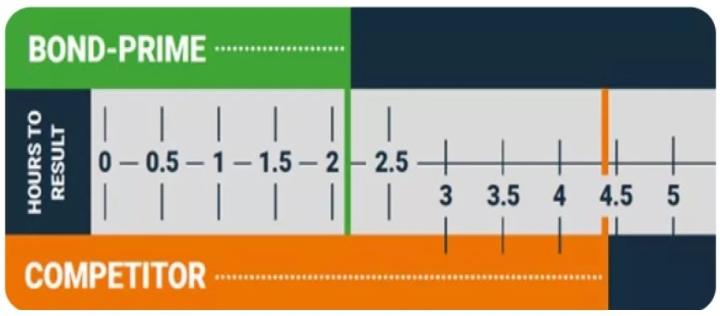
The results were conclusive – BOND-PRIME was shown to offer significant TAT improvements, with the urgent case turnaround time (TAT) reduced by 50% from over four hours to around two.
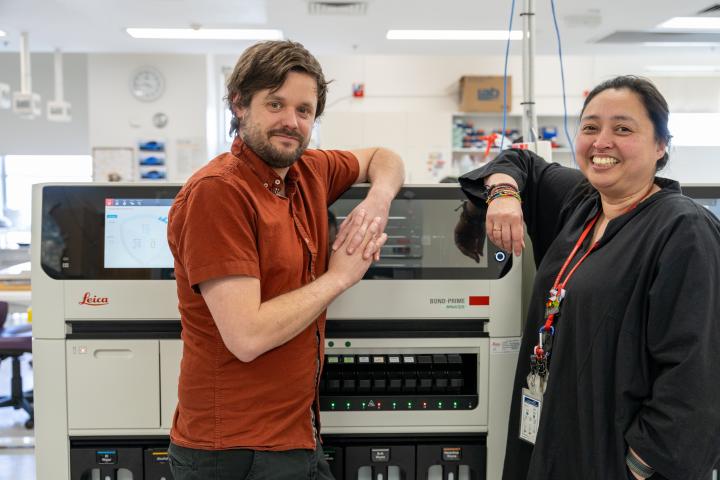
If two BOND-PRIME instruments had been in place (instead of the three existing instruments), this would have resulted in:
- Timely treatment
- Less patient anxiety
- Boost to staff morale
- Enhanced workflow
- Case TAT down by 50%
- Greater overall efficiency
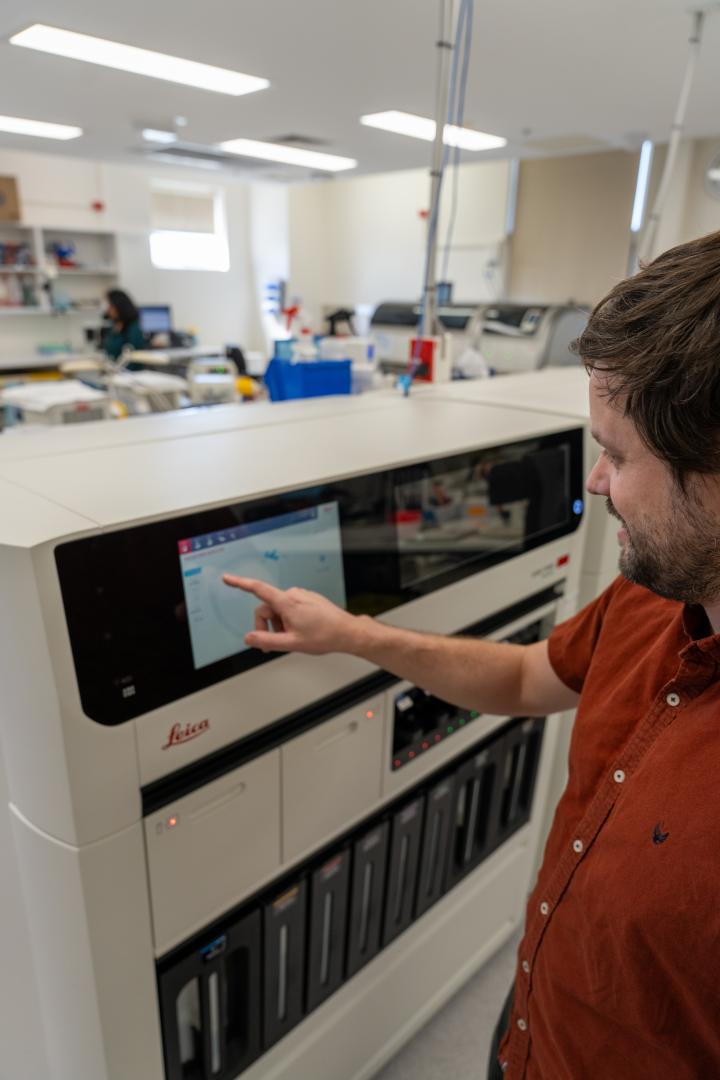
The Anatomical Pathology (AP) team at Eastern Health is proud of the role played in the patient journey, especially as they predominately handle life-threatening diagnoses. Through no fault of their own, they felt they had let their patient down, causing unnecessary delay and anxiety before treatment could start.
As Ms Marsden made clear: “The flow-on effect of having faster results means a bigger impact on patient care and the hospital more broadly. If we had had BOND-PRIME in place, the patient would have started their treatment the next day.”
Existing workflow
The AP laboratory is part of Eastern Health, a 621-bed hospital that supports the largest metropolitan area within the Australian state of Victoria.
Within AP, the immunohistochemistry (IHC) section is staffed five days a week with two IHC staff members each working an eight-hour shift. The IHC lab processes approximately 25,000 slides per year, a workload that had required three IHC/ISH instruments from another global company.
Even so, the three-instrument system struggled with TAT targets especially when faced with fluctuating staff levels and a sudden increase in urgent cases. The lab needed all three IHC/ISH stainers to meet demand and was also unable to increase capacity without affecting workflow.
The Box Hill pharmacy operates a 2 PM cut-off time. This enabled it to meet demand for specialist medications required for the next day’s treatment or procedures. Clinicians are used to working within this timeframe and keep the laboratory informed. The pharmacy would normally close on public holidays and weekends.
And then the unexpected happened–an unplanned public holiday was declared at short notice. This was to take place on a Thursday, the day before another scheduled holiday, creating a four-day weekend. Given the short notice, the hospital continued to operate as normal. The lab was scheduled to process 452 formalin-fixed paraffin-embedded (FFPE) blocks, resulting in 72 IHC slides, with fewer staff on duty that day.
At 8.30 AM, the reporting pathologist sent a request for a 12-slide urgent IHC case to confirm a lymphoma diagnosis before the weekend, so that treatment could start the next day.
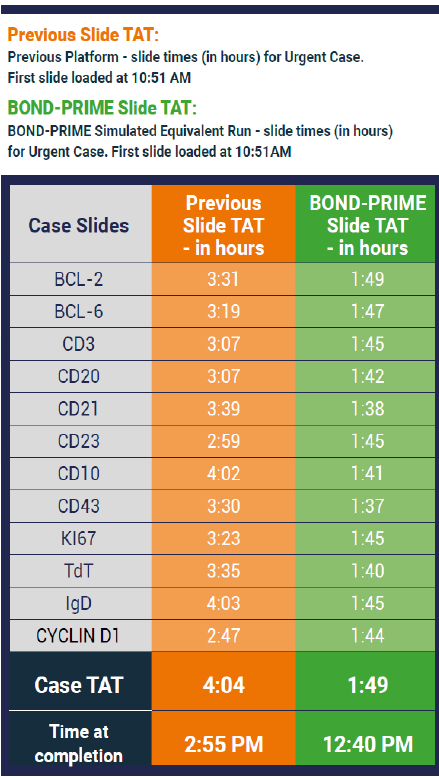
The IHC staff member on duty took immediate action, preparing and baking the slides so that the instruments could start running them by 10.51 AM. Four hours, three minutes after the processing started the last urgent slide was completed (2.55 PM) so the pathologist could quickly review the case. But it was too late. The pharmacy cut-off passed 90 minutes earlier.
The clinician had to inform the patient that they did indeed have cancer - but would have to wait four days before starting treatment.
Comparative BOND-PRIME study
The lab’s original audit had convinced the executive board that fundamental workflow changes were needed. The BOND-PRIME comparative TAT study was set up to validate it – replicating the workflow and timeframe that led to the four-day treatment delay.
A complete set of 72 slides was used, replicating the original Box Hill IHC requests run on the three existing instruments. The slides were split across two BOND-PRIME instruments, with allocated antibodies pre-loaded at the start of the day. Care was taken to load them at the same timepoints. Slides were placed separately into the Preload Drawer to be scheduled and loaded into staining modules.
The result was a clear win for the BOND-PRIME, confirming that the two-instrument IHC/ISH system from Leica Biosystems, delivered an urgent case TAT that was twice as fast as the original three instruments.
If this urgent case had been completed as fast on that Thursday holiday, the pathologist would have reported the lymphoma diagnosis to the oncologist well before the pharmacy cut-off. Treatment could then have started the next day.
Improving quality of lab life
This compelling evidence validated the laboratory’s audit and the executive board’s decision to change to a new IHC/ISH system. The lab now runs separate workflow platforms, with two BOND-PRIME IHC/ISH instruments handling 95% of IHC antibodies. It retained just one original instrument for a few specific assays. And a final word from Joel Dowsett, the IHC coordinator, on what it is actually like for the lab’s technical staff to use the instruments. He explained: “I particularly like the ability to preload slides, the constant reagent access, and reduced time investment on maintenance. The speed, ease of use, and reduced ‘hands-on’ time of the BOND-PRIME has improved the workflow and quality of life for the IHC scientist.”
“Excellent immunohistochemical staining with strong clean stains and very rapid turnaround…. allowing reports to be validated without delay”
—Senior Pathologist
Outcomes
- Faster throughput
- Increased workload with fewer instruments
- Patients received their diagnosis faster
- Reduced staff stress
- Improved collaboration with clinical colleagues
- Minimum one night hospital stay, not three or four
For In Vitro Diagnostic Use
Related Content


Die Inhalte des Knowledge Pathway von Leica Biosystems unterliegen den Nutzungsbedingungen der Website von Leica Biosystems, die hier eingesehen werden können: Rechtlicher Hinweis. Der Inhalt, einschließlich der Webinare, Schulungspräsentationen und ähnlicher Materialien, soll allgemeine Informationen zu bestimmten Themen liefern, die für medizinische Fachkräfte von Interesse sind. Er soll explizit nicht der medizinischen, behördlichen oder rechtlichen Beratung dienen und kann diese auch nicht ersetzen. Die Ansichten und Meinungen, die in Inhalten Dritter zum Ausdruck gebracht werden, spiegeln die persönlichen Auffassungen der Sprecher/Autoren wider und decken sich nicht notwendigerweise mit denen von Leica Biosystems, seinen Mitarbeitern oder Vertretern. Jegliche in den Inhalten enthaltene Links, die auf Quellen oder Inhalte Dritter verweisen, werden lediglich aus Gründen Ihrer Annehmlichkeit zur Verfügung gestellt.
Vor dem Gebrauch sollten die Produktinformationen, Beilagen und Bedienungsanleitungen der jeweiligen Medikamente und Geräte konsultiert werden.
Copyright © 2026 Leica Biosystems division of Leica Microsystems, Inc. and its Leica Biosystems affiliates. All rights reserved. LEICA and the Leica Logo are registered trademarks of Leica Microsystems IR GmbH.