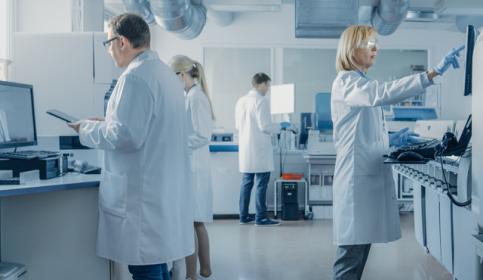


Histology Sample Preparation

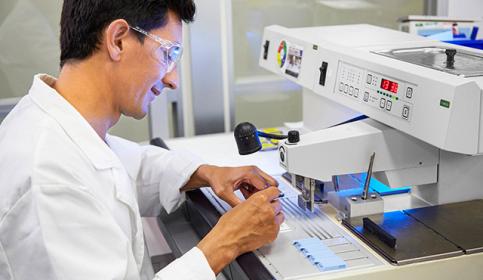
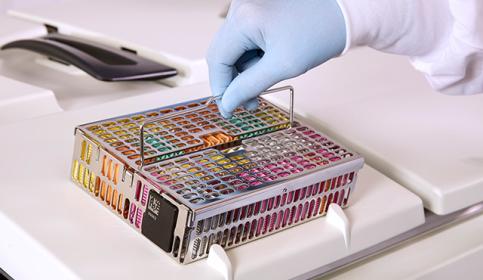
Histology sample preparation prepares tissue specimens for sectioning, staining and diagnosis. The standard paraffin process (tissue processing) moves specimens through a series of steps so the soft tissue is supported in a medium that allows sectioning. The standard steps are: Fixation that preserves the tissue, Processing that dehydrates, clears and infiltrates the tissue with paraffin wax, Embedding that allows orientation of the specimen in a “block” that can be sectioned and is easy to store and handle, and Sectioning using a microtome to produce very thin sections that are placed on a microscope slide ready for staining. Frozen sectioning is an alternative preparation technique that quickly freezes tissue to preserve it and provide sufficient hardness so it can be sectioned immediately using a cryostat. This technique is often used during surgery where the surgeon needs to locate a tumor margin to ensure it has all been removed.
Related Topics
-
Article06. Mar 2012 Institute: Leica Biosystems, Wetzlar, GermanyFixation is a critical step in the preparation of histological sections. If it is not carried out under optimal conditions or if fixation is delayed, a tissue specimen can be irreversibly damaged. No matter how much care is subsequently taken in tissue processing, microtomy and staining, the… Read article
-
Article06. Mar 2012 Institute: Leica Biosystems, Wetzlar, GermanyThis second part of the Fixation and Fixatives series covers the factors that influence the rate and effectiveness of tissue fixation as well as looking at two common fixatives: formaldehyde (histology) and glutaraldehyde (ultrastructural electron microscopy studies). Read article
-
Article06. Mar 2012 Institute: Leica Biosystems, Wetzlar, GermanyAs well as formaldehyde and glutaraldehyde, discussed previously, a number of other reagents have been used for fixation, sometimes in simple solution but often combined with other agents in the form of compound fixatives. The more important of these are discussed here in Part 3 of the Fixation and… Read article
-
Article06. Mar 2012 Institute: Leica Biosystems, Wetzlar, GermanyIn this fourth part of the Fixation and Fixatives series, we look at some of the many popular and traditional fixative solutions that have been used in histology for the last 100 years. This part also has an overview of proprietary solutions and provides advice on how to select the right… Read article
-
Article06. Mar 2012 Institute: Leica Biosystems, Wetzlar, GermanyIn this final part of the Fixation and Fixatives series we look at practical ways to optimise fixation quality, discuss how heat effects fixation and finish with an introduction to the relatively new field of microwave fixation. Read article
-
Webinar06. Feb 2012 Institute: Strata Pathology Services Inc., Lexington, MA, USAJoin Clifford M. Chapman, MS, HTL(ASCP), QIHC, technical director, Strata Pathology Services Inc., Lexington, MA, on April 26 from 2-3 p.m. for a free webinar on quality management for the histology laboratory. Read article
-
Tutorial18. Oct 2011 Institute: Leica Biosystems, Wetzlar, GermanyFrom time to time, in all histopathology laboratories, paraffin blocks will be encountered that are difficult or even impossible to section. This publication provides guidance on how to deal with these difficult blocks to get the best possible section, and how to identify and avoid a repeat of… Read article
-
Tutorial03. Jun 2011 Institute: Leica MicrosystemsSample tracking systems help reduce misdiagnosis by positively identifying patient tissue throughout the diagnostic process. Read article
-
Tutorial30. May 2011 Institute: Leica Biosystems, Wetzlar, GermanyAn introduction to the preparation of specimens for microscopy in the histopathology laboratory. Read article
-
Article27. May 2011 Institute: Pathology Innovations, LLC, Wyckoff, NJ, USAAnyone who has visited Dr. Peter’s website tutorial on frozen section techniques knows that he is a true believer in the brush technique. Let’s learn how he teaches this valuable skill to his resident. Read article
-
Tutorial26. May 2011 Institute: Leica Biosystems, Wetzlar, GermanyMicroscopic analysis of cells and tissues requires the preparation of very thin, high quality sections (slices) mounted on glass slides and appropriately stained to demonstrate normal and abnormal structures. Most fresh tissue is very delicate and easily distorted and damaged and it is thus… Read article
-
Article21. Apr 2011 Institute: Pathology Innovations, LLC, Wyckoff, NJ, USAThis article describes a system used for embedding of tissues for the preparation of frozen sections. This novel system uses simple techniques and apparatus to accomplish face-down embedding in freezing-temperature steel wells. The system is easy to learn and offers many advantages over conventional… Read article
- 1
- 2
Useful Links
Human Histology & Introductory Pathology
histology.leeds.ac.uk/what-is-histology/
Basic introduction to histology
www.pathologyoutlines.com/
Comprehensive textbook of surgical and clinical pathology
pathmd.com
Educational tools for pathology residents and physicians
www.path.uiowa.edu/virtualslidebox/
Virtuel Slidebox for histology and histopathology
teaching.anhb.uwa.edu.au/mb140/
Blue histology - broad coverage of histology
library.med.utah.edu/
Health science library
Histotechnology
stainsfile.info/StainsFile/jindex.html
Useful information about dyes, stains and staining
www.ihcworld.com/index.htm
Information Source for immunohistochemistry
www.bristol.ac.uk/vetpath/cpl/histmeth.htm
Useful information on staining techniques
Organizations and Discussion Groups
www.histonet.org/
Histonet - listserver for the histology profession
www.nsh.org/
The National Society for Histotechnology
www.hgv.org.au/
The Histology Group of Victoria
www.hgq.org.au/
Histotechnology Group of Queensland
www.histonsw.org.au/
Histotechnology Group of NSW
Quality Assessment Programs
www.ukneqas.org.uk
United Kingdom National External Quality Assessment Service
www.nordiqc.org/
Nordic Immunohistochemical Quality Group
www.rcpaqap.com.au/
The Royal College of Pathologists of Australia
www.nsh.org/content/all-about-histoqip
HistoQIP quality assurance program
Search Engines
www.histosearch.com/
Search engine for histology information
www.antibodybeyond.com/
Comprehensive information source about antibodies and IHC
www.gopubmed.com
Search interface for pubmed
en.wikipedia.org/wiki/List_of_academic_databases_and_search_engines
List of academic databases and search engines
scholar.google.com
Beta of Google's search engine for scientific abstracts
Journals
jcp.bmj.com/
Journal of Clinical Pathology
www.pathologyinpractice.com/
Pathology in Practice - practical solutions, news, case studies
www.doaj.org/
Directory of open access journals
www.sciencemag.org/
Science
www.nature.com/
Nature
www.plosone.org/home.action
International, peer-reviewed, open-access online publication
Useful Text Books
Human Histology & Introductory Pathology
Young B, O’Dowd G, Stewart W, (2010): Wheater's Basic Pathology: A Text, Atlas and Review of Histopathology (5th ed.)
Kerr JB. (2010): Functional Histology (2nd ed.)
Mescher AL. (2009): Jun queira's Basic Histology ( 12th ed.)
Eroschenko VP. (2007): diFiore's Atlas of Histology with Functional Correlations (11th ed.)
Young B, Lowe JS, Stevens A, Heath JW (2006): Wheater's Functional Histology (5th ed.)
Histotechnology
Stephen R. Peters (2009): A Practical Guide to Frozen Section Technique. Springer-Verlag.
Carson F, Hladik C. (2009): Histotechnology: A Self-Instructional Text. (3rd ed.)
Kiernan J. (2008): Histological and Histochemical Methods: Theory and Practice. (4th ed.)
Bancroft JD, Gamble M. (2007). Theory and Practice of Histological Techniques. (6 th ed.) online publication
Your bookmarks are missing?
Please send us your useful links!