



A single BOND-PRIME can process the work of two BenchMark ULTRA instruments.1
Updated Date: 15 October 2026
A laboratory considering changing their IHC/ISH workflow from BenchMark ULTRAs to BOND-PRIMEs wanted to understand the gains that BOND-PRIME would deliver to their laboratory. Knowing that a comparative run between a single BOND-PRIME and a single ULTRA showed that a BOND-PRIME would complete slides faster, the lab wanted to see if a single BOND-PRIME could deliver the throughput of two of their ULTRA instruments on a standard workday. The lab selected archival staining run reports from two of their ULTRA instruments on a single day that represented average slide loading numbers and included single DAB, single RED and double sequential staining protocols. The slide loading data was consolidated into a single run list. A replicate of these slides was run on a single BOND-PRIME instrument with slides loaded at the same time points in a like for like continuous mode. This test was then repeated with two different ULTRA instruments reports representing different protocol usage scenarios.
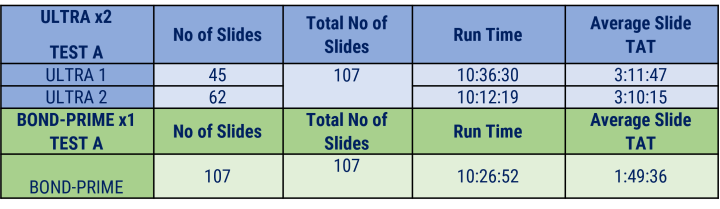
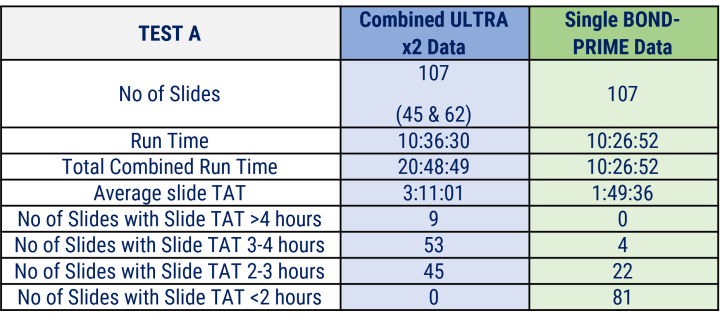
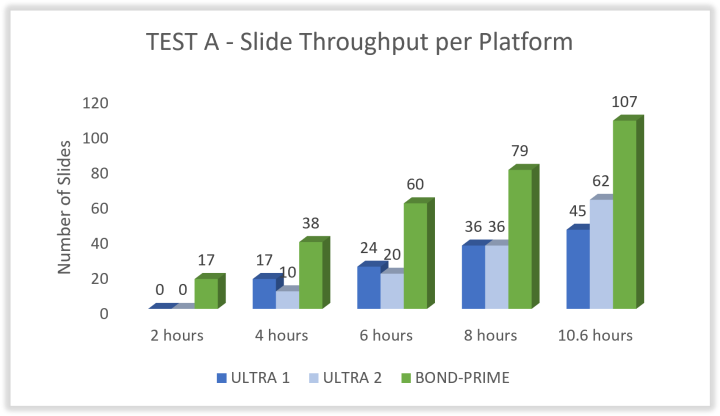
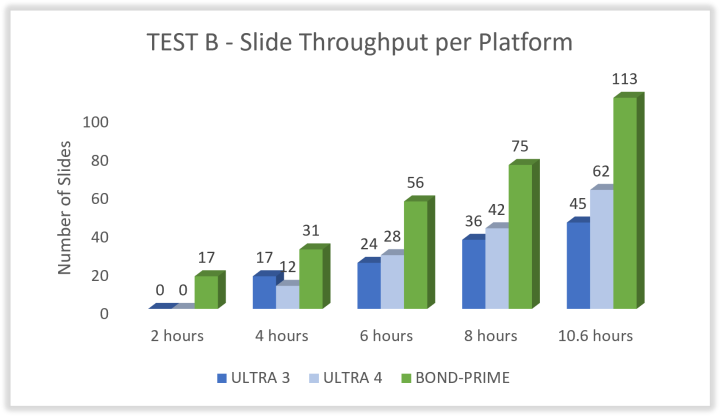
In a repeatable outcome, two tests demonstrated that one BOND-PRIME instrument could achieve the same slide numbers in the same amount of time as two BenchMark ULTRA instruments when run in a continuous mode as per this laboratory’s IHC workflow.
TEST A – 107 slides – 10.5 hours
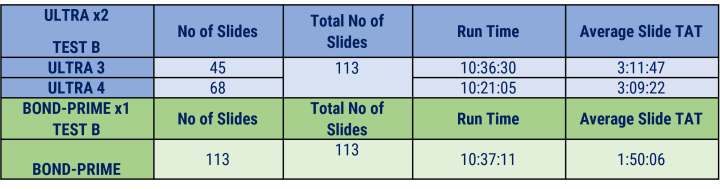
TEST B – 113 slides – 10.5 hours
Two BenchMark ULTRAs
One BOND-PRIME
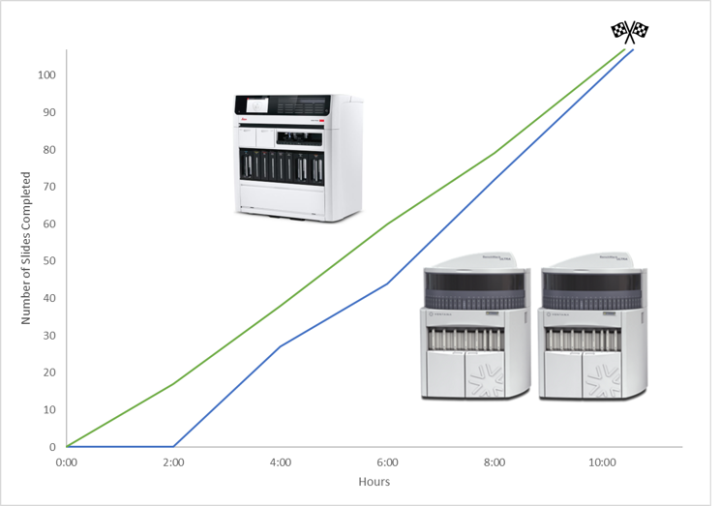
TEST A
Test A consisted of a combination of two BenchMark ULTRA runs with a total of 107 slides processed. These slides included the following protocols:
- 79 IHC DAB chromogen slides
- 23 IHC Red AP chromogen slides
- 5 IHC sequential double stained slides with both DAB and Red AP chromogens
TEST B
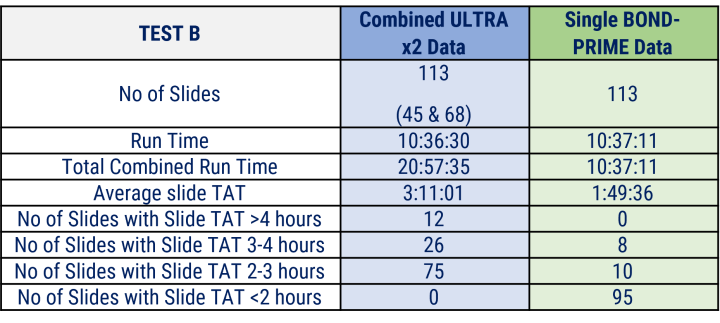
Test B consisted of a combination of two BenchMark ULTRA runs with a total of 113 slides processed. These slides included the following protocols:
- 105 IHC DAB chromogen slides
- 8 IHC sequential double stained slides with both DAB and Red AP chromogens
Summary of Potential Gains
Evaluating the comparative results of TEST A, and TEST B multiple benefits that this laboratory could realize can be determined.
- In this continuous slide loading workflow, a single BOND-PRIME completed the work of two BenchMark ULTRAs in the same amount of time giving this laboratory the opportunity to change their IHC/ISH lab to BOND-PRIME instruments at a ratio vs BenchMark ULTRA of 1:2.1
- A single BOND-PRIME instrument will regularly complete more slides earlier in the day than the two BenchMark ULTRA instruments even when processing slides at a ratio of 1:2.2
- When continuously processing 100+ slides in this laboratory’s workflow with a 1:2 ratio BOND-PRIME vs BenchMark ULTRA, 100% of the BenchMark ULTRA slides TAT is greater than two hours, while 80% of the BOND-PRIME slides TAT is under two hours.1
- Changing the laboratory IHC/ISH workflows to a BOND-PRIME system at a ratio of 1:2 vs the previous BenchMark ULTRA system will deliver savings to this laboratory,
- Floor space
- BOND-PRIME dimensions = 1217(w) x 831(d) mm3
- BenchMark ULTRA dimensions = (1118(w) x 841(d) mm) x 24
- Waste volume and waste container management
- BOND-PRIME average waste volume = 57mLs per DAB IHC slide5
- Separated into
- 19mL Standard waste.
- 38mL Hazardous waste.
- 4.5L waste containers require emptying every 200 slides.5
- Separated into
- BenchMark ULTRAs average waste volume = 165mLs per DAB IHC slide6
- Single waste container with no separation of components.4
- Quarterly decontamination procedures generate up to a further 40L of waste.4
- 20L waste carboys require emptying every 90 slides.4
- BOND-PRIME average waste volume = 57mLs per DAB IHC slide5
- Instrument maintenance
- BOND-PRIME IFU recommended maintenance, not including daily reagent top-ups, is 6 hours per year.5
- BenchMark ULTRA IFU recommended maintenance, referring just to the quarterly decontamination procedures, state there is 10 hours of instrument maintenance per year, per instrument associated to this task alone.4
- It can be strongly hypothesized that laboratory resource requirements can also be reduced across multiple activities,
- Hands-on touch points for one instrument vs two would see a general reduction.
- Instrument QC and validation for one instrument vs two would require less resource time and use of consumables.
- Instrument QC documentation for one instrument vs two would be halved.
- Floor space
FOR IN VITRO DIAGNOSTIC USE
1These results are applicable for the Test A & B scenarios as described here for this laboratory and cannot be used as a standalone claim. Individual results may vary.
2As referenced in Tests A & B, in Case Study 230327 Rev A_BOND-PRIME completes slides earlier with less hands-on time and in Case Study 220218 Rev C_ Comparing the throughput of the BOND-PRIME IHC system to a traditional IHC platform
391.7500.501 BOND-PRIME User Manual
4750-600 BenchMark ULTRA Advanced Staining System Operator Guide
5220856 Rev B_BOND-PRIME Maintenance and Bulk Reagent Management Flyer
6190374 Rev D_BOND-III proves superior to BenchMark ULTRA Flyer
Related Content


Leica Biosystems content is subject to the Leica Biosystems website terms of use, available at: Legal Notice. The content, including webinars, training presentations and related materials is intended to provide general information regarding particular subjects of interest to health care professionals and is not intended to be, and should not be construed as, medical, regulatory or legal advice. The views and opinions expressed in any third-party content reflect the personal views and opinions of the speaker(s)/author(s) and do not necessarily represent or reflect the views or opinions of Leica Biosystems, its employees or agents. Any links contained in the content which provides access to third party resources or content is provided for convenience only.
For the use of any product, the applicable product documentation, including information guides, inserts and operation manuals should be consulted.
Copyright © 2026 Leica Biosystems division of Leica Microsystems, Inc. and its Leica Biosystems affiliates. All rights reserved. LEICA and the Leica Logo are registered trademarks of Leica Microsystems IR GmbH.