



BOND Research to BOND Clinical Translation Guide
Updated Date: 17 October 2026
Supporting Assay Development with a Pathway Toward Clinical Deployment
Develop Today. Translate Tomorrow.
Biomarker and companion diagnostic programs can lose momentum when promising research assays must be redeveloped, re-optimized, or substantially reworked before they can move toward clinical implementation. The BOND RX and BOND RXm research systems support assay development in a flexible research environment while keeping future BOND clinical ecosystem considerations in view from the start.
Built within the broader BOND staining ecosystem, these research systems align with the technology, workflow, and reagent foundations used across Leica Biosystems clinical platforms, helping teams plan a more direct and efficient path to clinical translation.
Why Develop on the BOND RX and BOND RXm Research Systems?
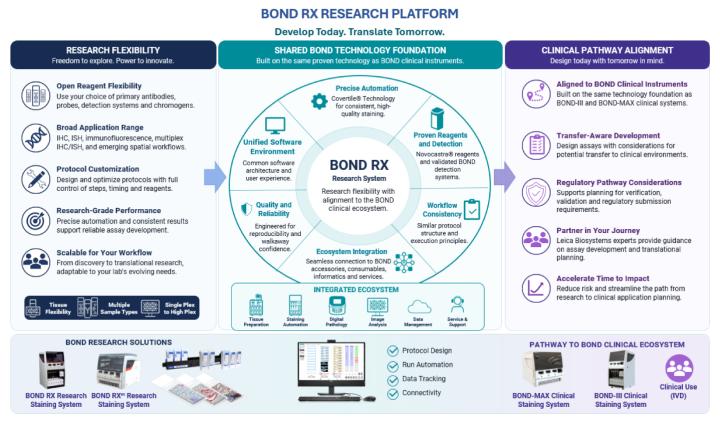
Researchers require flexibility to explore biomarkers, investigate novel workflows, and optimize assay performance. Clinical systems, by design, operate within a more controlled environment intended to support diagnostic laboratory workflows. When the research platform and the intended clinical deployment environment differ substantially, teams may face redevelopment, revalidation, workflow redesign, retraining, readiness delays, and increased cost.
The key benefit of developing within the BOND ecosystem is not that transfer is automatic. Instead, the research and clinical pathway can be planned against shared technology foundations, common workflow principles, and a related reagent and protocol environment from the beginning.
Shared Technology Foundations
Common Staining Technology
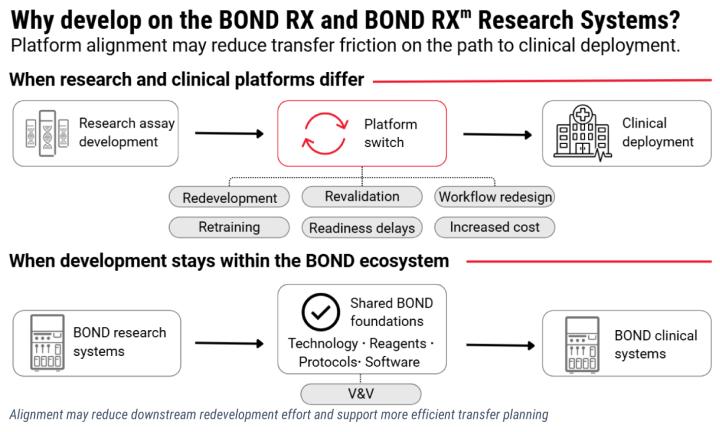
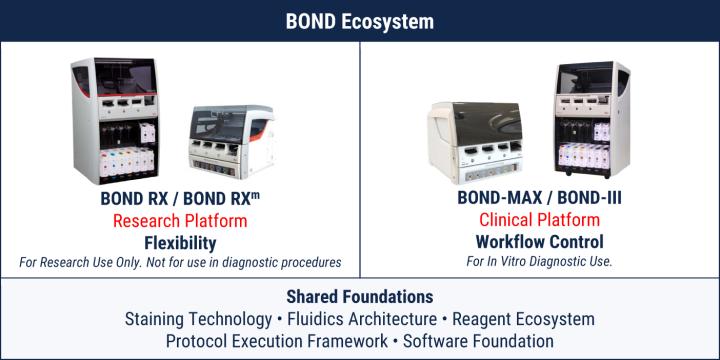
The Leica Biosystems BOND research platforms and BOND clinical platforms are positioned around common staining technology foundations. This includes comparable workflow principles, fluidics design philosophy, reagent ecosystem, and protocol execution framework. By enabling assay development within the broader BOND ecosystem, researchers can focus on scientific innovation while maintaining awareness of future clinical deployment objectives.
Shared Applications
- Immunohistochemistry (IHC)
- In Situ Hybridization (ISH)
- Chromogenic multiplex assays
- Fluorescent multiplex assays
- Translational biomarker studies
- Companion diagnostic feasibility programs
- Laboratory Developed Test (LDT) development
Common Software Foundation
BOND Research and BOND Clinical software applications are built upon a common software foundation.
The primary differences between research and clinical software environments relate to:
- User permissions
- Protocol editing capabilities
- Available workflow features
- Research-specific functionality
- Clinical workflow controls
Research and Clinical Environment Comparison
| Capability | BOND Research Systems | BOND Clinical Systems |
|---|---|---|
| Protocol flexibility | Extensive | Controlled |
| Sequential multiplexing | Up to 6-plex | Up to 4-plex |
| Research assay development | Yes | Limited |
| Clinical workflow controls | Limited | Enhanced |
Shared Reagent Ecosystem
Many Leica Biosystems reagents are available across both BOND research and clinical environments, including:
- BOND Ready-to-Use antibodies
- BOND Detection Systems
- BOND Epitope Retrieval Solutions
- BOND Wash Solutions
- BOND Ancillary Reagents
Choosing clinically relevant IVD reagent families during development can reduce avoidable changes when transitioning from research to clinical implementation. Unlike RUO reagents, IVD reagents are supported by documented performance characteristics and controlled product information—such as stability, shelf-life and lot-to-lot consistency data—providing greater confidence when planning a future clinical assay.
Designing for Future Clinical Translation
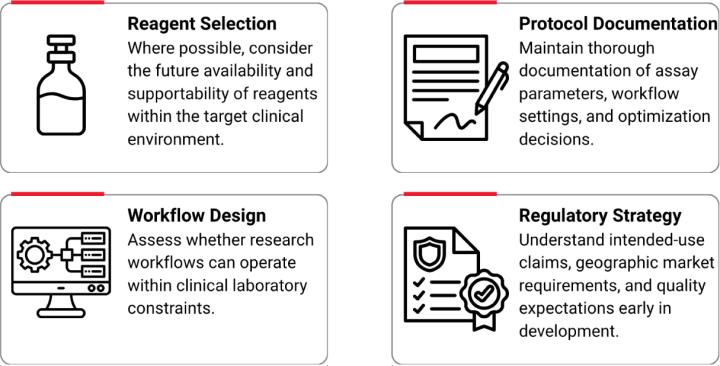
Organizations intending to transfer assays from research into a clinical environment should consider future deployment requirements during assay development.
Early consideration of transfer requirements may reduce downstream redevelopment effort and help avoid unnecessary technical challenges.
Examples include:
Research-to-Clinical Assay Development Pathway
A typical translational development pathway may include:
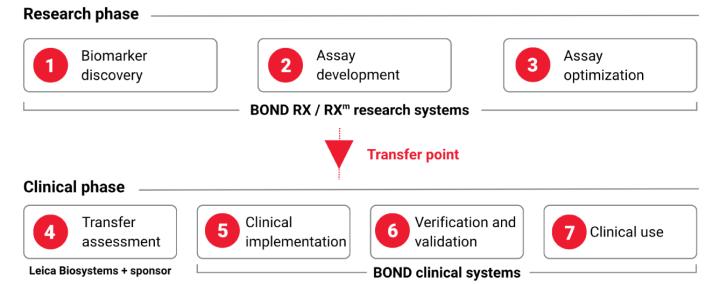
The exact pathway will depend on:
- Intended use
- Regulatory pathway
- Geographic market
- Assay complexity
- Sponsor quality requirements
Leica Biosystems: Enabling and Supporting Clinical Translation
Leica Biosystems supports clinical translation in two complementary ways.
- A clinical-ready ecosystem
The BOND ecosystem provides access to established clinical platforms and a broad portfolio of detection systems, antibodies, retrieval solutions, wash solutions and ancillary reagents. Selecting clinically relevant platform components early may reduce avoidable changes, redevelopment and technical uncertainty when an assay moves toward clinical implementation. - A development partner for clinical and companion diagnostic programs
Beyond supplying platforms and reagents, Leica Biosystems can collaborate with customers throughout the development pathway—from early feasibility and assay optimisation to clinical development, evidence generation, regulatory planning and commercial deployment. Our clinical and companion diagnostic development capabilities enable customers to engage the expertise, infrastructure and support needed at each stage of the journey.

Leica Biosystems can work with customers to identify factors that may influence future transfer strategies and implementation planning.
Factors That May Affect Transferability
BOND research and clinical systems share relevant foundations, but transferability of a specific assay depends on the details of assay design and the sponsor’s intended clinical application.
Factors that may require additional assessment include:
| Consideration | Potential Impact |
|---|---|
| Custom reagents | Additional development effort |
| Research-only antibodies | Clinical suitability assessment |
| Novel chemistries | Additional verification |
| High-order multiplex designs | Clinical implementation review |
| Workflow customizations | Clinical compatibility assessment |
| Regulatory requirements | Validation and documentation needs |
| Intended use claims | Transfer planning considerations |
Identifying these factors early can simplify future deployment planning.
Clinical Translation Expertise in Practice
RNAscope Technology Translation
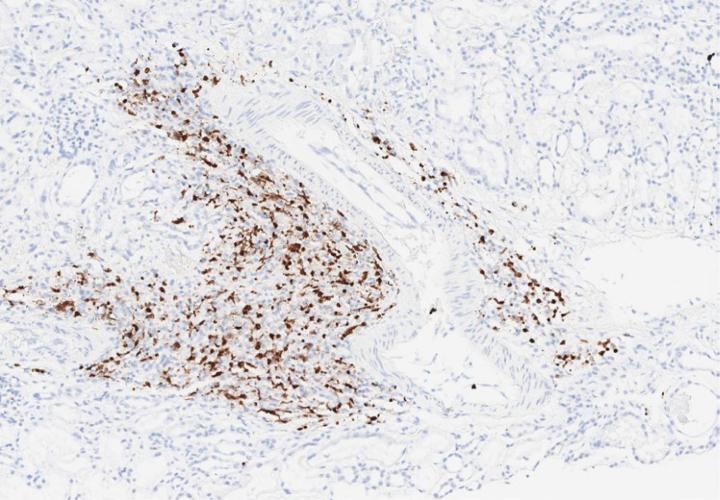
A practical example of research-to-clinical translation within the BOND ecosystem is Leica Biosystems' collaboration with Bio-Techne Spatial (original partnership with Advanced Cell Diagnostics). Research users may perform RNAscope workflows on BOND RX staining system using research reagents, like the RNAscope 2.5 LSx Reagent Kit (Brown, while related RNAscope-based solutions are also available within the BOND clinical ecosystem through BOND RNAscope Detection Reagents – Brown*.
This example demonstrates how technologies initially deployed within research environments can subsequently be adapted for clinical workflow deployment when appropriate development, validation, and regulatory activities are completed.
*BOND RNAscope products intended use and regulatory status depends on the specific product and region.
Clinical Adoption of the BOND Ecosystem
The BOND clinical ecosystem has been used with FDA-cleared and approved products.
Examples include:
BOND Oracle HER2 IHC System
The BOND Oracle HER2 IHC System is FDA PMA approved for use on BOND-MAX clinical instruments and represents one example of a clinically deployed assay within the BOND ecosystem.
BOND MMR Antibody Panel
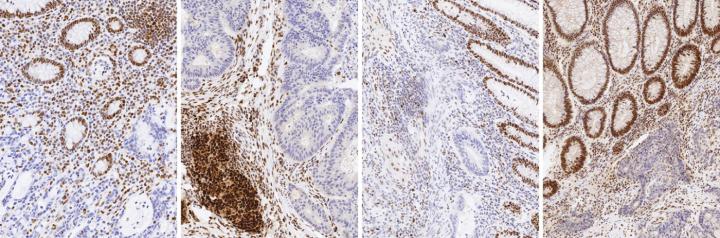
The BOND MMR Antibody Panel received FDA 510(k) clearance (K213348) for use on BOND-MAX and BOND-III clinical systems.
Companion Diagnostic Collaborations
Leica Biosystems has publicly disclosed collaborations with pharmaceutical and biotechnology organizations for companion diagnostic development and commercialization.
These examples demonstrate adoption of BOND clinical platforms but do not imply regulatory approval or clearance of customer-developed assays.
Frequently Asked Questions
Can I develop an assay on BOND RX research system and later transfer it to BOND-III clinical system?
Transfer suitability depends on the assay design, reagents, protocol, intended use, target market and required verification, validation, and regulatory activities. The customer should engage Leica Biosystems early to assess the most appropriate transfer strategy.
Are the staining technologies aligned between research and clinical systems?
Yes. Leica Biosystems designed BOND research systems and BOND clinical systems using common technology foundations, workflow architecture, protocol execution principles, and reagent ecosystems.
Can BOND research systems support studies that may contribute to a future regulatory submission?
Organizations may conduct research and assay-development activities on BOND research systems. Acceptability of resulting data for regulatory purposes remains the responsibility of the assay sponsor and applicable regulatory authorities.
Does protocol transfer eliminate verification or validation requirements?
No. Verification, validation, risk management, quality system compliance, and regulatory requirements remain dependent on intended use, claims, geography and the sponsor’s development pathway.
Important Regulatory Considerations
BOND research staining systems are Research Use Only (RUO) instruments and are not intended for diagnostic procedures. Transfer of an assay from a research platform to a clinical platform does not eliminate sponsor-specific responsibilities relating to:
- Verification
- Validation
- Risk management
- Regulatory submissions
- Intended-use claims
- Quality system compliance
Customers should consult Leica Biosystems regarding specific transfer strategies, implementation planning, and regulatory considerations.
Conclusion
BOND RX and BOND RXm research systems provide researchers with the flexibility needed to innovate while remaining aligned with the Leica Biosystems clinical staining ecosystem.
Through common technology foundations, shared reagent frameworks, aligned protocol architectures, and established clinical deployment platforms, BOND research systems can serve as an effective starting point for translational research, laboratory-developed tests, and companion diagnostic programs.
By considering future clinical objectives early in assay development and collaborating with Leica Biosystems throughout the process, organizations can reduce technical uncertainty and establish a potential pathway from biomarker discovery through to clinical implementation.
BOND-MAX and BOND-III are For In Vitro Diagnostic Use.
BOND RXm and BOND RX are For Research Use Only. Not for use in diagnostic procedures.
Leica Biosystems 콘텐츠는 Leica Biosystems 웹사이트 이용 약관의 적용을 받으며, 이용 약관은 다음에서 확인할 수 있습니다. 법적고지. 라이카 바이오시스템즈 웨비나, 교육 프레젠테이션 및 관련 자료는 특별 주제 관련 일반 정보를 제공하지만 의료, 규정 또는 법률 상담으로 제공되지 않으며 해석되어서는 안 됩니다. 관점과 의견은 발표자/저자의 개인 관점과 의견이며 라이카 바이오시스템즈, 그 직원 또는 대행사의 관점이나 의견을 나타내거나 반영하지 않습니다. 제3자 자원 또는 콘텐츠에 대한 액세스를 제공하는 콘텐츠에 포함된 모든 링크는 오직 편의를 위해 제공됩니다.
모든 제품 사용에 다양한 제품 및 장치의 제품 정보 가이드, 부속 문서 및 작동 설명서를 참조해야 합니다.
Copyright © 2026 Leica Biosystems division of Leica Microsystems, Inc. and its Leica Biosystems affiliates. All rights reserved. LEICA and the Leica Logo are registered trademarks of Leica Microsystems IR GmbH.