



Winning Strategies in the Next Decade in Pathology: Key Takeaways from Executive War College




Updated Date: 8 September 2026

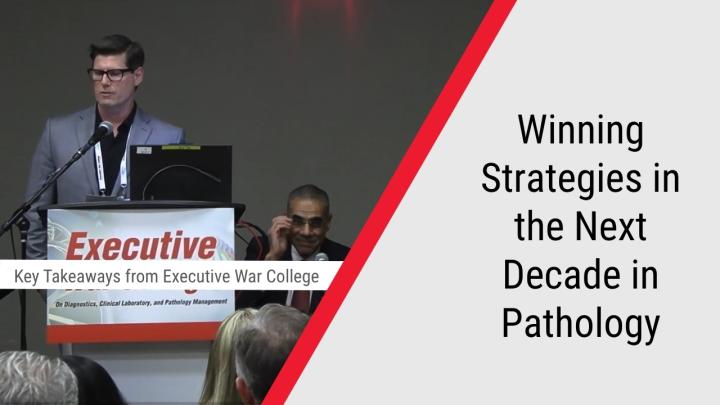
The Leica Biosystems-sponsored panel discussion at Executive War College, “Winning Strategies in the Next Decade in Pathology,” brought together pathology leaders to explore how digital pathology, AI enabled workflows, and predictive CDx are shaping the future of diagnostics. The session delivered a highly engaging and insightful exchange, combining thoughtful perspectives with moments of lighthearted dialogue among some of the top leaders in our industry.
Mark Frushone, Global Director of Commercial Development Digital Pathology at Leica Biosystems, asked the experts about how pathology organizations can prepare for what’s next through enterprise wide operational readiness, AI powered digital workflows, and predictive, AI driven companion diagnostics (CDx) to support precision medicine and future ready diagnostic excellence.
Watch the Panel Discussion
Here are some key takeaways:
Takeaway 1: How is AI changing pathology's impact across the patient care continuum from laboratory operations to diagnostics to AI-enabled assays? And how is this redefining pathology's value to the health system?
AI is already transforming pathology’s day-to-day efficiency. “Even in our practice, we really have seen multiple and numerous workflow-related efficiencies. That’s already established,” noted Dr. Mohamed Salama. “Diagnostic accuracy and standardization? That’s coming next.”
In essence, AI’s most immediate and proven value in pathology is operational efficiency: reducing turnaround time, manual slide handling, and costs, while setting the foundation for future gains in diagnostic accuracy, precision medicine, and integrated care.
Dr. Anil Parwani has implemented AI algorithms for prostate, breast, and other cancers in his practice. He described three key ways AI is transforming pathology: workflow optimization before case review, augmented analysis during slide interpretation, and built-in quality assurance after review. He described how AI can even prioritize cases, “putting the cases which have cancer ahead in the pile,” as he put it; still a “pile,” even if it’s now entirely digital.
AI is not just making pathology faster; it’s making expertise more accessible and effective, allowing a limited workforce to keep up with growing demand while improving diagnostic quality. Reflecting on how this changes the role of the pathologist, Dr. Derek Welch noted, “Even though the tools are not absolutely perfect yet, a pathologist wielding those AI tools is better than either one of them alone.”
Takeaway 2: How should health system leaders evaluate the real return on investment (ROI) of digital pathology and AI beyond productivity? And where is that value being realized today?
The real ROI of digital pathology and AI is not just speed. It’s the systematic redistribution of routine diagnostic work to automation, freeing clinicians to focus on higher-value decision-making while improving consistency and scalability across the lab.
“If you have 100 cases to review today, how can some of those tasks be more automated?” Dr. Parwani asked. “There are tasks which are autonomous…that can take away a lot of the tasks that a pathologist would spend doing, measuring things, annotating things.”
Digital pathology is also enabling consolidation of labs. This is a “benefit when it comes to the go forward for pathology and hospital systems,” noted Dr. Welch.
In a hospital system with multiple hospitals, there is often a lack of homogeneity across pathology providers. Dr. Welch referred to it as “a quilt work of different, independent pathology groups.” This fragmentation is exactly what makes consolidation so critical moving forward. Digital pathology enables consolidation by decoupling pathologists from physical locations, allowing cases, expertise, and workflows to be centralized and managed across an entire health system rather than within individual hospitals. And, just as importantly, it allows health systems to tap into subspecialty expertise on demand, without duplicating resources across sites. Increasingly, this is not just an advantage, but a necessity for health systems operating in the private sector.
According to Dr. Salama, ROI for digital pathology and AI must be evaluated across multiple dimensions, most importantly, quality and clinical impact, not just productivity.
| ROI dimension | Digital Pathology Value Details |
|---|---|
| Workflow efficiency | The most directly measurable component of ROI, including reductions in manual steps such as slide retrieval and improvements in overall process efficiency. |
| Diagnostic quality and patient safety values | Historically seen as subjective, but increasingly measurable through metrics such as amended report rates, misdiagnoses, second opinion concordance, and overall error reduction. |
| Downstream clinical revenue impact | The ability to drive additional value through areas such as companion diagnostics, clinical trial enrollment, and more informed utilization or avoidance of molecular testing. |
| Workforce resilience and strategic positioning | Strengthening access to specialty and subspecialty expertise, improving recruitment and retention, and positioning pathology as a more integral, future-ready part of the health system. |
Takeaway 3: When will AI meaningfully accelerate subspecialty pathology?
The main takeaway from the panelists: AI is already enabling faster, more efficient subspecialty support today by automating routine tasks, triaging cases, and augmenting diagnostic insight, though its use must remain grounded in validated, patient-safe applications.
Takeaway 4: How are organizations evolving metrics and management to drive digital adoption?
The main takeaway from the panelists: Organizations are shifting to data-driven management models, introducing new quality metrics, end-to-end workflow visibility, and dedicated digital teams to ensure adoption is measurable, accountable, and aligned to ROI and clinical value.
Expert Predictions on the Next Decade in Pathology
As this discussion made clear, the next decade in pathology will not be defined by a single breakthrough, but by the coordinated advancement of digital infrastructure, AI-enabled workflows, and predictive diagnostics working in concert. The leaders on this panel emphasized that success will depend on more than adopting new tools; it will require enterprise-wide alignment, measurable outcomes, and a clear vision for how pathology contributes to patient care across the continuum.
AI is already delivering tangible gains in efficiency and scalability, while laying the groundwork for improved diagnostic accuracy and more personalized treatment strategies. At the same time, digital pathology is enabling new operating models, from system-wide consolidation to expanded access to subspecialty expertise. Together, these innovations are redefining pathology’s value, not as a back-end service, but as a strategic, data-driven engine for clinical decision-making and precision medicine.
In summary
Organizations that invest in operational readiness, embrace data-driven management, and evaluate ROI through the lens of quality, clinical impact, and long-term resilience will be best positioned to lead. The opportunity is clear: to elevate pathology into a more integrated, insight-driven discipline that delivers measurable value for patients, providers, and health systems alike.
발표자 소개
Mark Frushone is the Global Director of Commercial Development Digital Pathology at Leica Biosystems, based in Vista, California. With over 25 years of experience in the healthcare industry, Mark has been a prominent leader in the field.
He joined Leica Biosystems in 2012 as a Market Manager for Emerging Markets, focusing on global digital pathology enablement. Prior to this role, Mark served as a Senior Application Specialist for the indirect channel at Aperio. Mark has been involved in the laboratory and digital pathology space for over 15 years.
Dr. Anil Parwani is a Professor of Pathology and Biomedical Informatics at The Ohio State University. He serves as the Donald A. Senhauser Chair of the Department of Pathology and the Chief of Pathology Services for the Health System.
Dr. Parwani has expertise in surgical pathology, pathology informatics, whole slide imaging, telepathology, image analysis, artificial intelligence, and lab automation. Dr Parwani has authored over four hundred peer-reviewed articles in major scientific journals and several books and book chapters.
Dr. Parwani has served on the board of directors, education committee and abstract committee for USCAP and was the president of digital pathology association. Dr. Parwani is the Editor-in-chief of Diagnostic Pathology and Co-editor of the Journal of Pathology Informatics.
Dr. Mohamed Salama is the Chief Medical Officer for Sonic Healthcare USA and is a Professor at the University of Texas Health Science Center, San Antonio School of Medicine. Previously, Dr. Salama has served as the Chief Medical Officer for Mayo Clinic Laboratories after serving as Chief of Hematopathology and Vice President for ARUP Laboratories. During that time, Dr. Salama held academic appointments a Professor of Laboratory Medicine and Pathology at Mayo Clinic School of Medicine and University of Utah, respectively. Dr. Salama completed his Anatomic and Clinical Pathology residency at the Henry Ford Health System in Detroit, Michigan, followed by a Surgical Pathology Fellowship at Stanford University and Hematopathology Fellowship at the University of New Mexico. Dr. Salama is certified by the American Board of Pathology for Anatomic and Clinical Pathology as well as Hematopathology.
Dr. Derek Welch is President and Chief Medical Officer of PathGroup and a board-certified pathologist who earned his medical degree from Vanderbilt University and completed his Clinical and Anatomic Pathology residency, serving as Chief Resident and Instructor.
Dr. Welch has published articles in peer-reviewed journals and has been a platform presenter at the U.S./Canadian Academy of Pathologists annual meeting. He is a Fellow of the CAP and Roger C. Haggitt Gastrointestinal Pathology Society.
Related Content

라이카 바이오시스템즈 Knowledge Pathway 콘텐츠는 에서 이용할 수 있는 라이카 바이오시스템즈 웹사이트 이용 약관의 적용을 받습니다. 법적고지. 라이카 바이오시스템즈 웨비나, 교육 프레젠테이션 및 관련 자료는 특별 주제 관련 일반 정보를 제공하지만 의료, 규정 또는 법률 상담으로 제공되지 않으며 해석되어서는 안 됩니다. 관점과 의견은 발표자/저자의 개인 관점과 의견이며 라이카 바이오시스템즈, 그 직원 또는 대행사의 관점이나 의견을 나타내거나 반영하지 않습니다. 제3자 자원 또는 콘텐츠에 대한 액세스를 제공하는 콘텐츠에 포함된 모든 링크는 오직 편의를 위해 제공됩니다.
모든 제품 사용에 다양한 제품 및 장치의 제품 정보 가이드, 부속 문서 및 작동 설명서를 참조해야 합니다.
Copyright © 2026 Leica Biosystems division of Leica Microsystems, Inc. and its Leica Biosystems affiliates. All rights reserved. LEICA and the Leica Logo are registered trademarks of Leica Microsystems IR GmbH.