



A single BOND-PRIME can process the work of two BenchMark ULTRA instruments.1
Updated Date: 15 October 2026
A laboratory considering changing their IHC/ISH workflow from BenchMark ULTRAs to BOND-PRIMEs wanted to understand the gains that BOND-PRIME would deliver to their laboratory. Knowing that a comparative run between a single BOND-PRIME and a single ULTRA showed that a BOND-PRIME would complete slides faster, the lab wanted to see if a single BOND-PRIME could deliver the throughput of two of their ULTRA instruments on a standard workday. The lab selected archival staining run reports from two of their ULTRA instruments on a single day that represented average slide loading numbers and included single DAB, single RED and double sequential staining protocols. The slide loading data was consolidated into a single run list. A replicate of these slides was run on a single BOND-PRIME instrument with slides loaded at the same time points in a like for like continuous mode. This test was then repeated with two different ULTRA instruments reports representing different protocol usage scenarios.
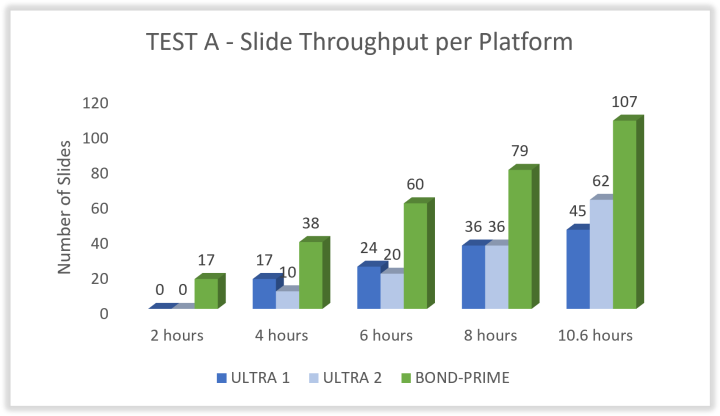
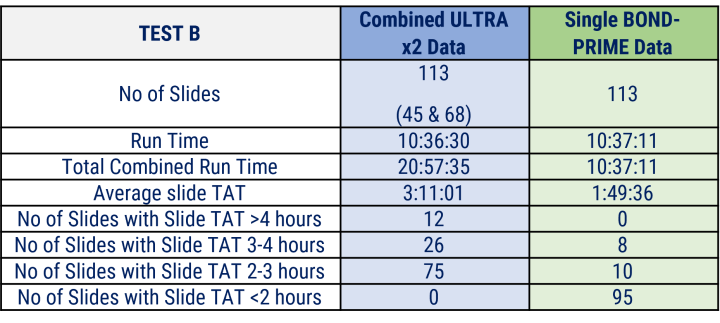
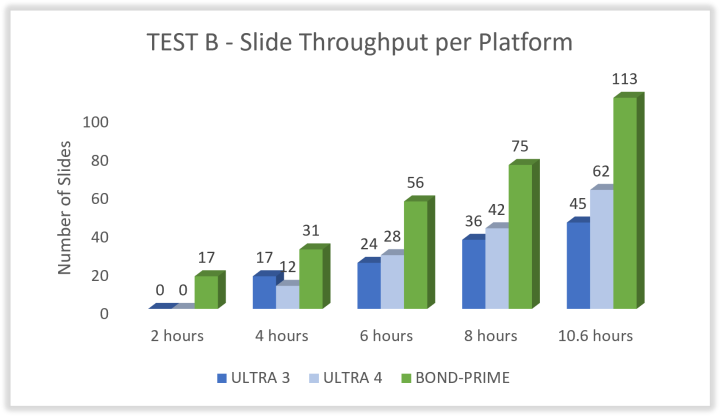
In a repeatable outcome, two tests demonstrated that one BOND-PRIME instrument could achieve the same slide numbers in the same amount of time as two BenchMark ULTRA instruments when run in a continuous mode as per this laboratory’s IHC workflow.
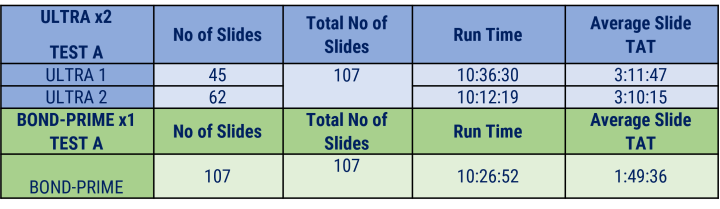
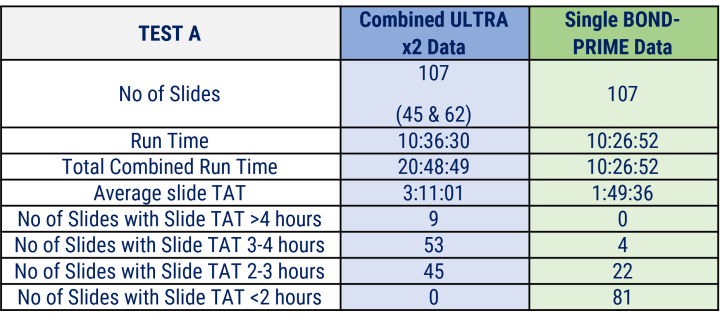
TEST A – 107 slides – 10.5 hours
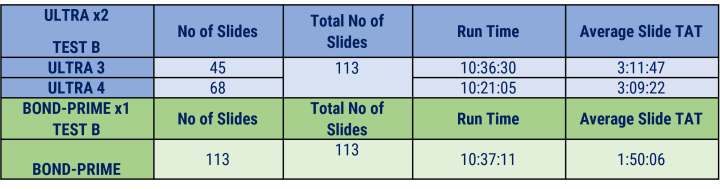
TEST B – 113 slides – 10.5 hours
Two BenchMark ULTRAs
One BOND-PRIME
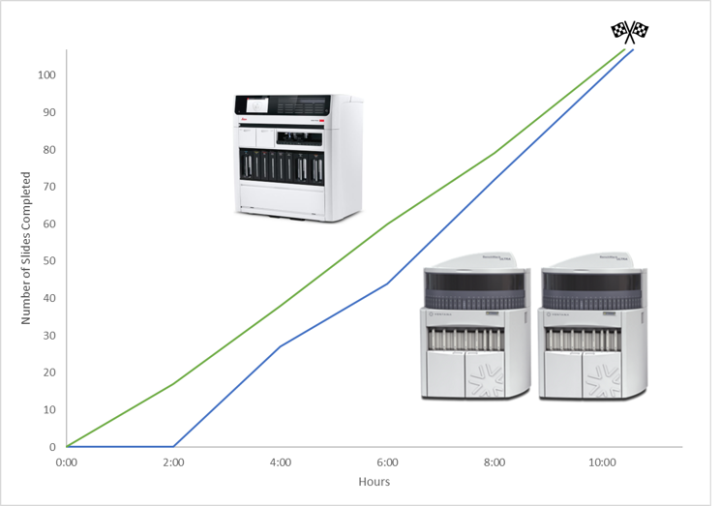
TEST A
Test A consisted of a combination of two BenchMark ULTRA runs with a total of 107 slides processed. These slides included the following protocols:
- 79 IHC DAB chromogen slides
- 23 IHC Red AP chromogen slides
- 5 IHC sequential double stained slides with both DAB and Red AP chromogens
TEST B
Test B consisted of a combination of two BenchMark ULTRA runs with a total of 113 slides processed. These slides included the following protocols:
- 105 IHC DAB chromogen slides
- 8 IHC sequential double stained slides with both DAB and Red AP chromogens
Summary of Potential Gains
Evaluating the comparative results of TEST A, and TEST B multiple benefits that this laboratory could realize can be determined.
- In this continuous slide loading workflow, a single BOND-PRIME completed the work of two BenchMark ULTRAs in the same amount of time giving this laboratory the opportunity to change their IHC/ISH lab to BOND-PRIME instruments at a ratio vs BenchMark ULTRA of 1:2.1
- A single BOND-PRIME instrument will regularly complete more slides earlier in the day than the two BenchMark ULTRA instruments even when processing slides at a ratio of 1:2.2
- When continuously processing 100+ slides in this laboratory’s workflow with a 1:2 ratio BOND-PRIME vs BenchMark ULTRA, 100% of the BenchMark ULTRA slides TAT is greater than two hours, while 80% of the BOND-PRIME slides TAT is under two hours.1
- Changing the laboratory IHC/ISH workflows to a BOND-PRIME system at a ratio of 1:2 vs the previous BenchMark ULTRA system will deliver savings to this laboratory,
- Floor space
- BOND-PRIME dimensions = 1217(w) x 831(d) mm3
- BenchMark ULTRA dimensions = (1118(w) x 841(d) mm) x 24
- Waste volume and waste container management
- BOND-PRIME average waste volume = 57mLs per DAB IHC slide5
- Separated into
- 19mL Standard waste.
- 38mL Hazardous waste.
- 4.5L waste containers require emptying every 200 slides.5
- Separated into
- BenchMark ULTRAs average waste volume = 165mLs per DAB IHC slide6
- Single waste container with no separation of components.4
- Quarterly decontamination procedures generate up to a further 40L of waste.4
- 20L waste carboys require emptying every 90 slides.4
- BOND-PRIME average waste volume = 57mLs per DAB IHC slide5
- Instrument maintenance
- BOND-PRIME IFU recommended maintenance, not including daily reagent top-ups, is 6 hours per year.5
- BenchMark ULTRA IFU recommended maintenance, referring just to the quarterly decontamination procedures, state there is 10 hours of instrument maintenance per year, per instrument associated to this task alone.4
- It can be strongly hypothesized that laboratory resource requirements can also be reduced across multiple activities,
- Hands-on touch points for one instrument vs two would see a general reduction.
- Instrument QC and validation for one instrument vs two would require less resource time and use of consumables.
- Instrument QC documentation for one instrument vs two would be halved.
- Floor space
FOR IN VITRO DIAGNOSTIC USE
1These results are applicable for the Test A & B scenarios as described here for this laboratory and cannot be used as a standalone claim. Individual results may vary.
2As referenced in Tests A & B, in Case Study 230327 Rev A_BOND-PRIME completes slides earlier with less hands-on time and in Case Study 220218 Rev C_ Comparing the throughput of the BOND-PRIME IHC system to a traditional IHC platform
391.7500.501 BOND-PRIME User Manual
4750-600 BenchMark ULTRA Advanced Staining System Operator Guide
5220856 Rev B_BOND-PRIME Maintenance and Bulk Reagent Management Flyer
6190374 Rev D_BOND-III proves superior to BenchMark ULTRA Flyer
Related Content


Leica Biosystems 콘텐츠는 Leica Biosystems 웹사이트 이용 약관의 적용을 받으며, 이용 약관은 다음에서 확인할 수 있습니다. 법적고지. 라이카 바이오시스템즈 웨비나, 교육 프레젠테이션 및 관련 자료는 특별 주제 관련 일반 정보를 제공하지만 의료, 규정 또는 법률 상담으로 제공되지 않으며 해석되어서는 안 됩니다. 관점과 의견은 발표자/저자의 개인 관점과 의견이며 라이카 바이오시스템즈, 그 직원 또는 대행사의 관점이나 의견을 나타내거나 반영하지 않습니다. 제3자 자원 또는 콘텐츠에 대한 액세스를 제공하는 콘텐츠에 포함된 모든 링크는 오직 편의를 위해 제공됩니다.
모든 제품 사용에 다양한 제품 및 장치의 제품 정보 가이드, 부속 문서 및 작동 설명서를 참조해야 합니다.
Copyright © 2026 Leica Biosystems division of Leica Microsystems, Inc. and its Leica Biosystems affiliates. All rights reserved. LEICA and the Leica Logo are registered trademarks of Leica Microsystems IR GmbH.